Friday, September 10, 2010

How to Dye a Rainbow

I was a good little professor and spent much of the summer hacking out two papers that I'd been wanting to write for some time. Yes, I must publish lest I perish, and I'm not even in a tenured position yet. I'd like to be, and so I must publish just to get on the publish-or-perish track. Yesterday I finished the second paper, which is now resting, and I will edit it next week and submit it to a journal.

So today I played.

I got out my copy of Hand Dyeing Yarn and Fleece that I'd been meaning to do something with ever since I got it back in May. With that, a box of food coloring, and a half-skein of KnitPicks Bare fingering-weight merino (this method only works with protein fibers: wool, silk, other animal fibers), I set to work on one of the projects in the book.

First, you make a dozen mini-skeins of 10 or 15 yards. Soak the yarn in a solution of one part white vinegar to three parts water:


Then you make your stock solutions of dye. A pint of warm water, a teaspoon of yellow, a half-teaspoon of red, and a quarter-teaspoon of blue:


Next, you mix your dye batches. Three of the jars have four tablespoons of the primary colors: yellow, blue and red. Between them you mix your secondary and tertiary colors: three tablespoons of yellow, one of blue; two tablespoons of yellow, two of blue; one tablespoon of yellow, three of blue; and so on around the jars. Already you've got the rainbow effect going. I have four extra jars for the box of neon food dyes that I wanted to try out: fuchsia, lime green, purple, and turquoise.


Then, as you might guess, you add the yarn. Squeeze out the excess vinegar solution and drop a mini-skein in each jar. Let it sit for about 30 minutes:


Turns out I had one extra skein, so I did a rainbow dip: the middle in yellow, one end in red, the other end in blue, and then the blue end in red again to make purple:


After the jars have soaked a while, you heat-set the dye. The quickest way to do that is to send them on a spin through the microwave for about two minutes, four jars at a time (the plastic-wrapped rainbow skein went in, too, sitting on top of a set of jars):


If everything goes well, the yarn should take up all of the dye molecules and the liquid should be clear. If it's not, try another minute in the microwave:


Once the jars are cool enough to handle, dump each one out in a strainer, squeeze out the liquid, and there you are!


I hung the yarn over the shower curtain rod to keep them out of reach of curious kitties while I went to the library, another treat because I haven't made it to our city library all summer. The university library, yes, but not our own library, just for my own self. I came back with Color in Spinning and The Essential Guide to Color Knitting Techniques, which will occupy much of this evening.

Once yarn was dry, I twisted it into skeins. Rainbow!


What I found out about food coloring is that the standard red and blue make a pretty unsatisfying purple, which I kind of thought would be the case, based on years of dyeing Easter eggs with food coloring. The purple that's mostly blue is okay, though it has mottling that show that the fiber took up more red pigment in some spots and more blue in others. The half red/half blue one is sort of a dull burgundy, and the mostly red one is sort of brick-colored. This might be because the standard red is more of an orange-red than a pure red. Great for making oranges, not so great for making purples unless you like very subdued, muddy purples. The purple from the neon colors box was much better.

And what do you do with a rainbow of mini-skeins? Um... mine are going into a jar for decoration and color reference for the future. I'm sure other folks could think of other creative things to do with them.


There's also a pattern in the book for a baby sweater that uses small amounts of hand-dyed yarn to make a rainbow yoke. Very pretty. It takes worsted-weight yarn, though, so not a project for my samples.

I can see this being the basis of a very colorful science fair project, too. It might be about color theory, or a kid might just use the primary colors and try to dye protein fiber (wool, silk, other animal fibers), cellulose fiber (cotton, linen, hemp, ramie, or even rayon), and man-made fibers. Comparing acrylic and nylon would be interesting, since acrylic doesn't take up acid-based dyes, but nylon does.

If you've had a hankering to try out a little home dyeing, this is a good book for getting started. Stock up on some undyed yarn and play with it for a while, then you'll be ready to tackle more complicated projects.

Monday, September 6, 2010

A textile history gem in the desert: Théâtre de la Mode at Maryhill

With summer waning, and both DH and I in the throes of the back-t0-school blues (see, one downside to being an educator is that there was no cheering in our household when the kids went back to school), we decided to get out of town for a day and see something interesting. We aimed the car north and then east, taking a drive up the Columbia River gorge, our end goal being the Maryhill Museum. Which I'll get to in a moment.

After leaving I-84 and taking the twisty, windy old historic Columbia River Highway, one of the first stops is Vista House on Crown Point, overlooking the west end of the gorge. Vista House was built in 1916 and recently restored.


From its observation decks, visitors get a view of the Columbia River gorge. This is looking east, the direction we were traveling.


The river cut through layer upon layer of Columbia Flood Basalts, creating spectacular cliffs. Where you have cliffs in this wet climate, you're bound to have waterfalls, and the gorge is full of them. Latourell Falls is easy to visit:


As is the famous Multnomah Falls, perhaps the most photographed waterfalls in the world after Niagara (the upper fall is over 500 feet high):


Once you get past the mountains, you're on the east side of the state, in the High Desert region. Here the cliff faces are covered with dry grass and dotted with sagebrush and the occasional non-native Russian olive.


And that is where, smack in the middle of nowhere, on the Washington side of the gorge (cross the Columbia at Hood River and have 50 cents ready for the toll), you find the Maryhill Museum of Art (if you squint, you can see Mt. Hood in the background).

Samuel Hill, one promoter of the Columbia River Highway, bought over 5000 acres in this area to found a Quaker farming community. He also began construction on a grand house for himself, modeled after his house in Seattle. Loïe Fuller, a pioneer of modern dance and a friend of Hill, talked him into using the house to create an art museum. Why they all thought that a grand house in the middle of practically nowhere would make a great site for an art museum is anyone's guess, but perhaps Hill believed that the town would grow into something much larger. Queen Marie of Romania, also a friend of Hill (who must have had an amazing social life) visited the unfinished museum for a very grand opening ceremony.

The museum now houses furniture and art donated by Queen Marie, a small collection of very fine Victorian art, including some pre-Raphaelite painters, some beautiful Orthodox Icons, an excellent collection of Rodin bronzes and sculptures, an amazing display of chess sets, beautiful Native American art (more on that, since some spectacular textiles were included in that display) and...

This:

Théâtre de la Mode was an odd and fascinating chapter in fashion history. The year was 1945, the location, Paris. World War II had come to an end and Paris was in the middle of rebuilding itself, and that included rebuilding the fashion industry. Paris was, after all, the fashion capital of the world. But in war-torn Europe there was little fabric to be had, and the fashion designers couldn't put together enough to create full-sized fashions to be worn by life models -- especially since the New Look that was about to be launched called for wide skirts over crinolines and far more bows and adornments than anyone could dare (or afford) to wear during the war years.

The solution was to do what fashion designers had done in centuries past: create and dress dolls to display new fashions.

So Théâtre de la Mode was born. Craftsmen created dolls with detailed faces, but wireframe bodies and limbs. Fashion designers dressed the dolls in their newest creations. Then, to show off the fashions in the best light possible, stage artists, including surreal film director Jean Cocteau, created theatrical settings to display the dolls.

The entire existing collection, stages and all, are housed at Maryhill. Nine stages exist, three of which are shown at a time in rotation in a room dedicated to the collection.


This stage, titled Ma Femme est une Sorcière (My Wife is a Witch), features a fainting bridesmaid, several women looking aghast, and the bride flying off on a broomstick through a hole in the roof of the decaying garret, while a city burns in the background. Decidedly a Jean Cocteau confection, n'est-ce pas?


Tonner Doll Company has dolls dressed in Théâtre de la Mode fashions for sale. You can see the Tonner doll (left side) and the original Théâtre de la Mode doll (right side) for each of the dolls offered.

If you're in the Pacific Northwest, resident or visitor, and have time for a drive up the gorge, don't miss out on the Maryhill Museum.

I'll get a report out on more textiles from the Native American traditions when DH finishes processing his photos.

Friday, August 27, 2010

Stash your cash or stash your stash

When it comes to creative hiding, few can beat the knitter in SABLE condition (stash accumulation beyond life expectancy) trying to hide excess stash... until now.

Today's Mint.com, a personal finance blog, has a great slideshow featuring creative, burglar-proof places to stow extra cash. My favorite?

The old "fake pipe in the basement" trick:


Now go check out Mint.com and see where else you can stash some cash -- or surplus stash. Or cash for more stash.

Tuesday, August 24, 2010

Fleurette de-fleured

So I've been working on the Fleurette Jacket, which by the pictures in the pattern is such a lovely little jacket.

The basic premise is that you knit a ribbed band in alternating stockinette/reverse stockinette from end to end until it's long enough to go around you, with the lower edge at your waist and the top at your lower ribs. Then you pick up stitches and knit down to make the lacy skirt part, and pick up stitches and knit up to make the upper jacket part. So it ought to be tailored to fit any figure, right?

I got this far:


when I realized that the back looked awfully narrow.

And that's when I finally spotted (hello, Captain Obvious) the basic flaw in the plan: It works if one has a body that is basically cylindrical, with no bust and no hips. True the pattern has one knit to different lengths to accommodate a larger bust size, but yanno, the width matters a just a little bit too, especially if one hasn't been a beanpole-shaped pre-teen for, well, a few years now.

Now, in all fairness, I had made a slight design change. Instead of putting the bottom edge of the band at the waistline, I wanted my natural waistline at the center of the band. That does make the band somewhat smaller to begin with, but still -- even with the open design of the lace, the skirt part doesn't flare out nearly enough for someone with actual female hips.

So... heavy sigh... I frogged everything back to the original waistband, whipped out paper, pen, and calculator, and set to with the math and all to figure out how to make this jacket into something real woman-shaped instead of slim dress-form shaped.


Having now picked up stitches and increased for the hip portion, we'll see how the rest of the jacket shapes up.

Saturday, August 21, 2010

Of sagebrush, deep space objects, and yarn, part 2

After staying up half the night on the mountaintop observatory, I was sure glad to be able to sleep late the next day. Which, as it turns out, I didn't -- I don't know why, but my eyes went "sproing" at the usual time, and while I tried to doze for another hour, I eventually got up well before I intended to. I brewed a good strong cup of tea and armed myself with iced tea to stay alert the entire 133 mile drive home over the mountains. It is not wise to nod off on winding mountain highways with steep drop-offs on one side. Nope.

On the way out I took a swift tour of the yarn shops of Bend and Sisters. I started with Gossamer, an upscale yarn shop in Bend:

Or at least, I tried to. I got there about a quarter after 10:00, since the website said they opened at 10:00, but alas, I missed the bit about summer hours. They wouldn't open until 11:00. Not wanting to sit around for 45 minutes, all I could do was get a shot of the fibrous wonders inside through the glass window:


I did find my way to Juniper Fiberworks, after a couple of false starts. I've got the DH's old GPS, and the GPS map has an old address for the store, which took me to totally the wrong end of town. Last time I'd been in Bend, Juniper had been at a different address from where the GPS wanted to take me, so I dashed back to the hotel, got a good wireless signal from my car, looked up the address (that, I guess, is the 21st century version of finding a telephone booth -- anyone remember those? -- and looking up an address in that old analog device, the telephone book), and discovered that Juniper had moved again since I last visited. And after finding the busy street where Juniper lives, and making several false turns on the way, I finally arrived:


Mmm, plenty of yarny goodness as a reward for all of that effort!

It was hard to choose exactly what to bring home as souvenir yarn, but I finally settled on a gold and silver skein of silk and cashmere from Artyarns:


That did it for Bend's selection of yarn shops, so I hit the highway west toward home.

As lovely as any trip out of town can be, sometimes the nicest part is coming home. And with views like this on the way, heck YEAH, the drive can be the best part of the trip:

That jagged peak on the left is Broken Top, and the snowy peak on the right is the South Sister. I was tooling along the highway between Bend and Sisters, thinking, "Ya know, with a view like that, it would be really cool if one of the ranchers around here would donate a few hundred square feet for a viewpoint pull-off..." and about that time I saw the blue sign saying, "Viewpoint, 1/2 mile." Wish granted! Unfortunately I couldn't see Mt. Bachelor from that spot, but I did have a gorgeous view of all of the Three Sisters:

Continuing the view from south to north, next comes Mt. Washington (the locals have other, more colorful names for the mountain based on its distinctive shape, but let's stick with the official name for now):


Then comes small, jagged, Three-Fingered Jack (I couldn't get the telephone lines to stand to the side, sorry):


Then Black Butte, and majestic Mt. Jefferson:


There's "Jeff" on zoom:


About 30 minutes of driving took me to the town of Sisters, originally a logging town which saw a terrible economic downturn in the 70s, but which rebuilt itself as a tourist mecca by doing all the store fronts in "Old West" style, installing upscale shops, and putting in hotels and such. The shop I homed in on was The Stitchin' Post. (Is that Old West enough for y'all?)


Originally a quilt and fabric shop, they've also added a nice selection of yarns:

Like this Rowan Lima alpaca blend that I came home with:

I stopped for lunch at a small park at the north end of Sisters, where I had a nice view of, well, the Sisters:


Then I pointed the car west and I was on my way home. I wish I could have gotten shots of the drive over the mountains, up out of the pines, up into the firs, over the alpine meadows, down toward Detroit Lake, but there weren't many safe places to pull over. Suffice it to say I took rest breaks and made it home safely, with new yarn to play with.

Friday, August 20, 2010

Of sagebrush, star clusters, and yarn, part 1

It's been a busy week! Not only did I make progress on my Fleurette jacket:


and some progress on my stealth socks in self-patterning Sockotta:


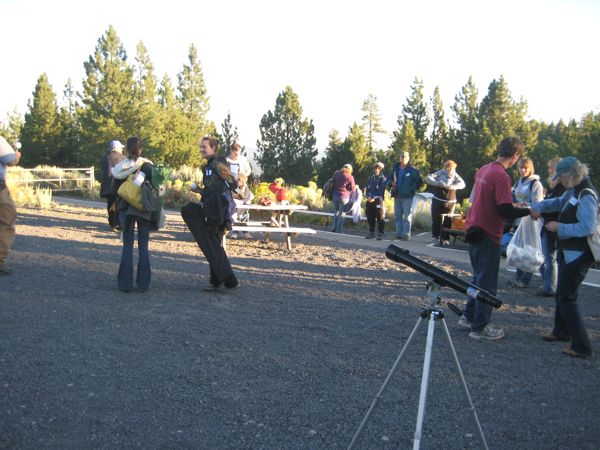
but I also spent the week being part of a week-long summer workshop, working with this group of elementary teachers in Bend, Oregon:
Yes, those are telescopes, and yes, we're out in the pines, juniper, and sagebrush... and we're also tromping around at 6500 feet, an elevation where the 80 degree day is about to become a 30 degree night. Why? Because that night we were on a field trip here:

That's one of the three domes at Pine Mountain Observatory, where we went for one of their educational outreach programs. From 7:00 until after midnight, we learned about the phases of the moon with physical models ("Now, holding out your moon model, stand so that your moon looks like the moon in the sky..."), learned why dark bands appear in the eastern sky as the sun sets (the umbra and penumbra of the earth itself), spotted Venus as she emerged as the evening star, watched the constellations come out and move around the sky, and trained the telescopes, including one of the big dome telescopes, on various objects in the sky. We saw star clusters, several nebulae, at least one galaxy, and all of the planets except Mercury.

Bend is in central Oregon, on the east side of the Cascades, where the mountains slope down in into high desert. Having taken a hotel room near the downtown area, I was within blocks of the main downtown area and lovely Drake Park, where I took my morning and evening walks alongside Mirror Pond -- actually the Deschutes River, excavated to be wide, shallow, and slow-moving:

Nice place to build a home... must be nice to afford that!

But you can't beat that neighborhood, really.

Even a pretty footbridge to get from one side of the park to the other.

Now, before this post gets too picture heavy, I'll cut off there and make y'all wait for the second post to learn about the sightseeing I looked forward to -- the yarn shops!

Saturday, August 14, 2010

Rather late for cherries...

...but not too late to spin up the BFL in Cherry Ripe colorway that came all the way from England:

I started on this during Tour de Fleece, and got a little way into the sherbet-colored mass. But spinning it down fine enough to make a 3-ply lace weight takes just a leeeetle time, does it not? There's something about spinning wool down to thread to make you feel invincible, like you can do anything (until, of course, you try to spin something thicker and can't any more, which is all it takes to make you feel like a schmuck again).

So it wasn't until recently that I got through all 4 ounces. Believe it or not, there's over a mile of spun wool on that bobbin.

And I know 'cause when I chain-plied it, I ended up with just over 500 yards of plied yarn.

Not too bad, huh? I'm still trying to get the color right on this. The digital camera picks up either a little too much yellow or a little too much blue.


I'm thinking about something like Annis for this yarn, and I've got just the pink cashmere pullover to go with it.

Want to see what else the cute little critter who dyed this wool is making? Pop over to The Princess Rooms on Etsy and look for Elianna's special sections.

Friday, August 13, 2010

Usurped!

No knitting is safe when the Princess Belle seeks a place to rest her fuzzy little head. Even whole knitting bags may be claimed by Her Royal Furness:

And yet she won't wear the sweaters I knit for her. Ingrate.

Sunday, August 1, 2010

All's Well with Ishbel

It started with a skein of Happy Hands Toe Jamz yarn from Sock Summit 2009, in A River Runs Through colorway:
Add to that, the pattern for the Ishbel shawl, and several dozen stitch markers. Y'see, like many others who have tackled this pattern, I found that the lace charts said to work 3 together where there were only 2 to work together and vice versa. Throw in forgotten YOs every now and then, and it becomes clear why marking every single repeat of the pattern was absolutely essential. So was working the 3-togethers or 2-togethers according to whatever made sense at the moment.

With 450 yards in the skein, I had a lot more than I needed for the smaller size, but less than I needed for the larger size -- so I did the stockinette center for the smaller size and the number of lace chart repeats for the larger size, and had plenty of yarn at the end.

And of course, when you're done knitting lace, you get this little crumpled thing:


Which you soak for a good long time to relax the fibers, stretch like crazy on the blocking boards with wires and pins, and let dry. If you have a cat to hold it down and add a fine patina of cat hairs, so much the better.

Once off the blocking boards, voila! Ishbel, and all is well!

We shall see how this does in the State Fair.
 

blogger templates | Make Money Online